uPVC Door Won't Lock? How to Tell a Dropped Door From a Failing Gearbox
If you are standing at a door whose handle will not lift, the most useful thing you can do in the next minute is nothing. Almost every expensive uPVC door repair starts as a cheap one, and the thing that turns it expensive is somebody heaving the handle upwards one more time. This guide gives you a quick test that separates the two real causes, tells you which one you can sometimes sort out yourself, and explains what to do if the door is already locked shut.
What is actually inside your door
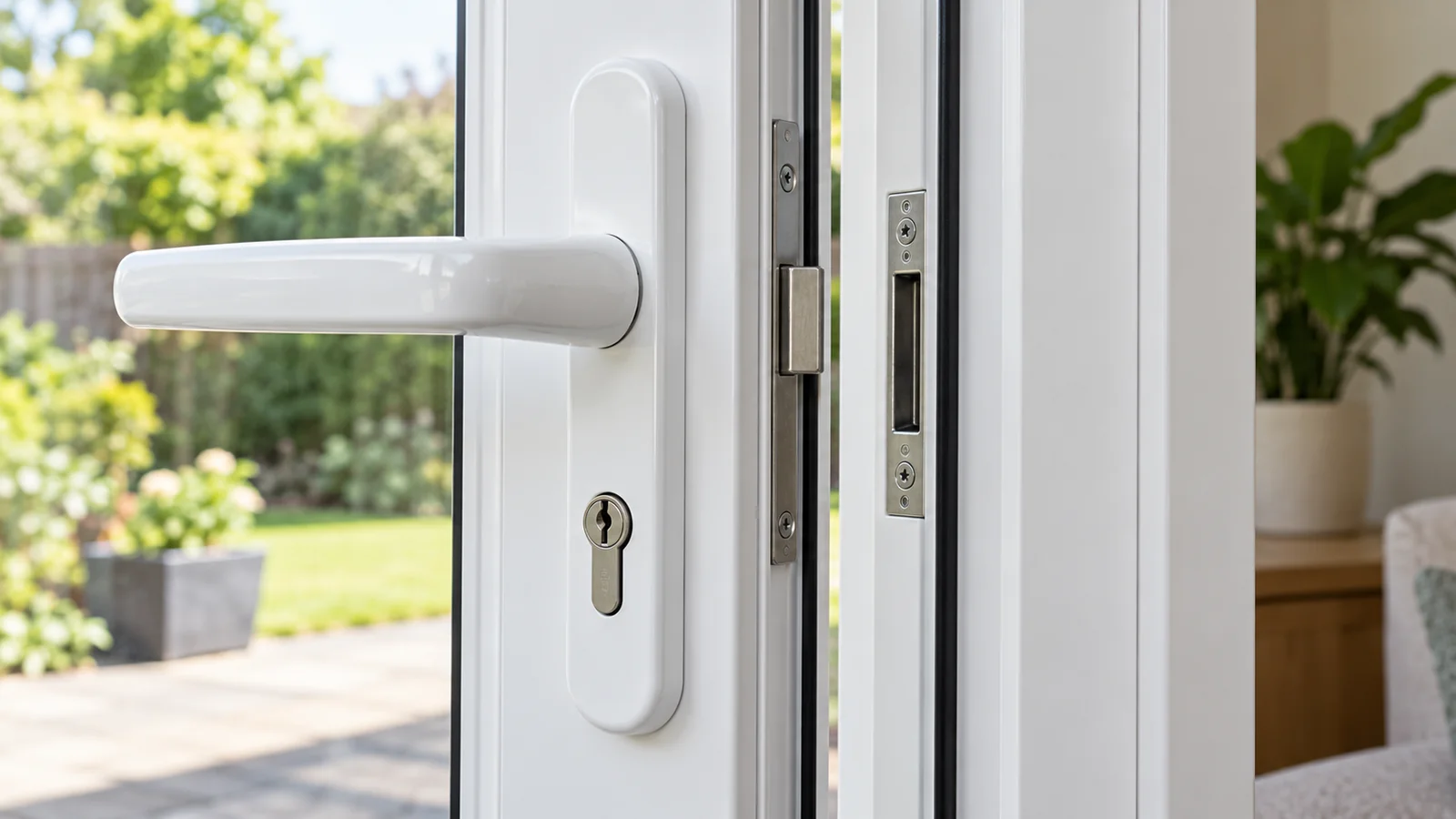
A uPVC or composite door is locked by a multipoint mechanism: a long steel strip down the leading edge of the door, carrying hooks, rollers, deadbolts or mushroom cams, all driven by a gearbox in the middle. Lifting the handle throws those points out into the keeps, the metal strike plates set into the frame. Turning the key in the euro cylinder then deadlocks the gearbox so the handle cannot be pushed back down.
That means there are only two ways the lift-to-lock action can fail. Either the hooks are no longer lining up with the keeps because the door has moved, or the gearbox that drives them is failing. The two feel similar at the handle, but they are completely different jobs, and one of them turns into the other if you force it.
The thirty-second test
Open the door wide, stand to one side of it, and lift the handle. Nothing is engaging the frame now, so you are feeling the mechanism on its own.
- The handle lifts smoothly and easily with the door open, but is stiff or impossible with the door closed. Your gearbox is fine. This is geometry: the door has dropped, racked or pulled tight against the seals, and the hooks are catching the edges of the keeps instead of sliding into them. This is usually an adjustment, not a new lock.
- The handle is stiff, gritty, crunchy or oddly spongy with the door open too. The problem is inside the mechanism. Grinding or crunching suggests a worn or chipped gearbox. A handle that lifts with no resistance at all and moves nothing suggests something inside has sheared. A handle that will not spring back down suggests the spring cassette has gone.
Two more checks sharpen the answer. If the handle lifts fine when you pull or push the closed door firmly towards the hinge side, or lift the leaf slightly by the handle, that is alignment. And if the key now spins round and round without ever feeling as though it has deadlocked anything, that points at the gearbox or the cylinder rather than the frame.
Why this happens now and not in July
Through the summer the gaskets are soft, the grease in the mechanism is thin, and a door that is a couple of millimetres out of true still works perfectly well. Then the weather turns. The profile contracts in the cold, the rubber gaskets stiffen and stop forgiving a tight fit, the grease thickens, and damp works on the steel inside the lock strip. In Belfast the winter problem is usually mild, wet and windy rather than hard frost, so stiffened seals and corrosion inside the mechanism matter as much as temperature does.
Underneath that there is almost always a slow drift that has been building all year: hinge wear, loose fixings, or the glazing packers inside the door shifting so that the heavy glass unit pulls the leading edge downwards. Cold weather does not break your door. It removes the tolerance that was hiding the drift.
Reading the evidence on the door
Before anybody picks up a screwdriver, look at three things.
- The gaps. Open the door and look at the gap between the leaf and the frame along the lock side, at the top and at the bottom. It should be even. If the gap is clearly wider at the top than at the bottom, or the door has to be lifted to shut, the leaf has dropped or racked. One or two millimetres is enough to stop a hook entering its keep.
- Witness marks on the keeps. Shine a torch into the frame. Bright scuffed metal above or below the mouth of a keep tells you exactly which points are missing, and in which direction. Scuffing above the mouth usually means the door has dropped.
- The hinges and fixings. Look for missing caps, loose screws, or a hinge that has visibly worn. Then wiggle the handle: a loose handle with slack screws feels a lot like a failing mechanism and is a two-minute fix.
What you can reasonably do yourself
Clean and lubricate. Wipe the lock strip and the hooks, then use a lubricant made for locks, typically a light PTFE or silicone-based spray, on the hooks, rollers, cams and the inside faces of the keeps. Use a dedicated cylinder lubricant in the keyway, sparingly. Avoid thick oils and grease, and avoid general-purpose water-displacing sprays as a long-term lubricant: they wash out the factory grease and then gum up with dust.
Tighten what is obviously loose. Handle fixing screws and hinge screws are fair game. Snug, not forced.
Make the smallest possible adjustment. Most uPVC hinges offer only a couple of millimetres of movement, and the keeps usually have a couple of millimetres of slot behind their screws. Work on one point at a time, move it a fraction, and retest with the door closed. Keep a note of what you changed so you can put it back. If you find yourself winding something to the end of its travel, stop: the door needs squaring up properly rather than forcing into adjustment.
What not to touch. Do not keep lifting a handle that has stopped. Do not lever it with anything, lean on it, or hit it. Do not slacken the glazing beads or move the packers unless you know how to re-pack a door, because that is how a working door becomes a door that will not shut at all. Do not remove the cylinder fixing screw and start pulling on the cylinder. And never shut a door with the hooks already thrown out, because you will damage the keeps and the frame.
If the door is already locked and will not open
Stay calm and stop turning the key. A key that snaps inside a cylinder turns a straightforward job into a longer one.
- Check you have the right key, and that it is not bent or badly worn. If you have a spare that has never been copied, try that one.
- Turn gently while taking the weight off the mechanism: pull or push the door firmly towards the frame, or lift it slightly by the handle, and try the key with light pressure. Relieving the load is often all it needs.
- Do not use pliers, grips or any kind of extension bar on the key, and do not force the handle to make the key turn.
- If somebody is shut in or out, or this is the only way out of the building, treat it as urgent. While you wait, make sure everyone knows where the second exit is and that nothing is blocking it.
When you ring a locksmith, the call goes much better if you can say: whether the door is open or locked shut; whether the handle lifts with the door open; whether the key turns at all; what the door is made of; the brand stamped on the lock faceplate or the handle, if you can read it; and whether anybody is trapped. That is usually enough for them to arrive with the right parts rather than coming back twice.
If the mechanism does need replacing
Multipoint mechanisms are not interchangeable, and "it looks the same" is how people end up with two wrong parts. The measurements that identify one are:
- Backset — from the front face of the faceplate to the centre of the cylinder keyway. Commonly 35 mm or 45 mm, though 25, 30, 40 and 55 mm all exist.
- Centres, often written PZ — from the centre of the cylinder keyway to the centre of the handle spindle. 92 mm is the most common on UK uPVC doors; 85 mm and 62 mm are also found.
- Faceplate width — the visible strip, often 16 mm and sometimes 20 mm or 22 mm, with either square or radius ends.
- Overall length of the strip, plus the number, type and position of the locking points: hooks, rollers, deadbolts, mushroom cams, or a mixture.
- Handle fixing centres, the distance between the two handle screws, if the handle is being changed as well.
Measure rather than assume, and note the brand if it is legible on the faceplate. A separate measurement that often gets confused with the above is the euro cylinder itself: that is measured from the centre of its fixing screw hole out to each end face, which is why cylinders are described as 35/45 and similar. Getting that one wrong leaves the cylinder protruding beyond the handle plate, which is a security problem in its own right as well as an untidy one.
A ten-minute autumn routine
- Check that the gaps around the leaf are even and that the door does not need lifting to shut.
- Clean and lubricate the hooks, rollers, cams, keeps and cylinder once a year, before the cold sets in.
- Tighten handle and hinge screws.
- Wipe the gaskets and treat them with a rubber-safe conditioner so they stay soft.
- Test every external door, including the back door and the garage side door, not just the one you use daily.
- If the handle has started needing a shove, book an adjustment while it is still only an adjustment.
The rule of thumb worth remembering is simple. A handle that is getting harder to lift is giving you notice. Acting on it in October is a small job; ignoring it until it stops is how you end up buying a mechanism.
Sources
- Master Locksmiths Association
- British Standards Institution
- Secured by Design
- Published fitting and maintenance documentation from multipoint lock and door hardware manufacturers