Smart Locks and UK Home Insurance: What to Check Before You Fit One
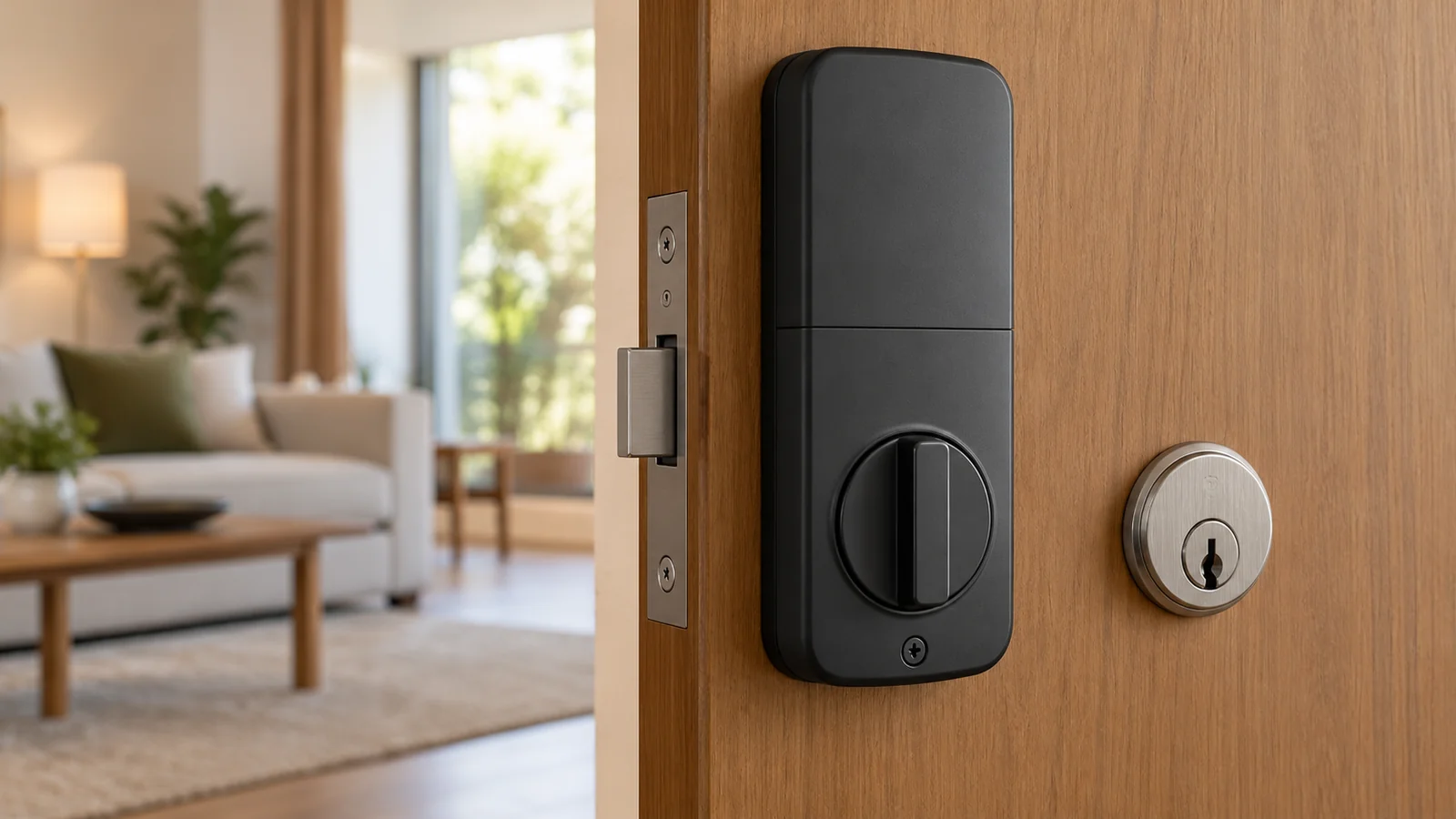
The question people ask is usually "will a smart lock invalidate my insurance?", and the honest answer is that it depends entirely on what your policy says and on what the lock replaces. Insurers are not interested in whether a lock is clever. They are interested in whether the locks on your doors matched the specification in your policy at the moment something happened. This guide shows you how to read your own wording, which types of smart lock cause problems and why, and exactly what to ask before you buy.
What an insurer is actually checking
Home insurance policies describe security in two places, and most people only read one of them. The policy schedule is the personalised page with your address and cover levels. The policy booklet contains the general conditions, the definitions and any endorsements. Security requirements live in the conditions and endorsements, and they usually take one of these forms:
- A named standard for the final exit door, for example a mortice deadlock conforming to BS3621 "or equivalent" on a timber door.
- A requirement for multipoint locking on uPVC, composite and patio doors.
- A requirement for key-operated locks to accessible windows.
- A condition that the locks must be in use whenever the home is left unoccupied, and sometimes overnight as well.
Two distinctions matter here. First, BS3621 and its relatives are British Standards, not law. Nobody can fine you for not having one. They bite only because your policy names them. BS3621 covers thief-resistant locks that can be opened from the inside with a key; BS8621 covers keyless egress, which is what you often need in a flat with a fire escape route; BS10621 covers locks that are key-locked from the outside only. The headline features people quote for BS3621 are five or more levers, a bolt that throws at least 20 mm into the frame, and hardened anti-drill protection, with a kitemark on the faceplate.
Second, a condition can be drafted as a general condition or as a condition precedent to liability. The wording "it is a condition precedent" or "we will not pay unless" is worth noticing, because those clauses are the ones that cause the most argument at claim stage. That is the paragraph to read twice before you change anything on a door.
What is not true is that fitting a smart lock automatically cancels your cover. Insurers do not go looking for gadgets. The risk is narrower and more specific: that the lock you remove to make room for the smart one was the lock your policy named, and nobody told anybody.
The types of smart lock, and how each one lands
Retrofit motors. These sit on the inside of the door and turn the existing thumbturn or cylinder for you. Because the original cylinder and the original key stay exactly where they were, the lock specification on your door is unchanged, and this is generally the least troublesome option from a policy point of view. Check that the unit does not stop the key working from outside, and that it does not interfere with a thumbturn you rely on for escape.
Smart euro cylinders. These replace the cylinder in a uPVC or composite door. Here the question becomes whether the new cylinder carries the security rating your policy or your insurer expects, typically TS007 three stars, or a one-star cylinder paired with two-star security handles to make up three stars, or Sold Secure Diamond. Many smart cylinders do not carry those ratings. If yours does not, you have changed the specification of the door, and that is the change worth declaring.
Motorised multipoint locks. These drive the hooks of the multipoint mechanism electrically. They are a bigger job, they must be matched to the door, and the certification that matters is for the whole assembly rather than a single component. Ask the supplier for the certification in writing and keep it with your policy documents.
Fully keyless deadbolts and latches. Many are designed around North American door construction and carry no BS or TS007 certification at all. On a UK timber final exit door, one of these fitted instead of a kitemarked deadlock is the clearest way to fall out of step with a policy condition. On a uPVC door, a keyless latch added without a working multipoint and a rated cylinder is the same problem in a different shape.
Smart handles and keypad escutcheons over euro profile vary enormously. Treat them as cylinders: find the rating, or assume there is not one.
Why a physical key override matters
A key override, a cylinder you can still operate with a metal key, is worth insisting on for two separate reasons.
The policy reason is that a good deal of UK wording still describes key-operated locking. A door that can only be opened electronically may not satisfy a clause written in those terms, which is why fully keyless products are the ones that most often fail to meet a minimum security requirement.
The practical reason is failure modes. Batteries go flat, usually on the coldest, wettest evening of the year. Electronics fail. Hubs lose power and internet connections drop. A keypad can become unreadable in bright sun or unusable with gloves on. If your only route in is electronic, your spare is a locksmith. Before buying, find out: how it warns you about low batteries, whether it opens without the app or the internet, whether it has an external emergency power contact, and where the override keyway is.
Timber doors and uPVC doors are different problems
On a timber door, the policy-relevant item is usually the mortice deadlock and its standard. Taking a kitemarked BS3621 deadlock off to fit a smart latch is a specification change, full stop. The usual sensible answer is to leave the deadlock in place and add the smart lock alongside it, or to use a retrofit motor on the existing lock.
On a uPVC or composite door, BS3621 is not the relevant benchmark at all. What matters is a sound multipoint mechanism plus a cylinder rated against snapping, and whether the smart product preserves both. One practical point from the workshop: if the handle on that door is already stiff to lift, fix the alignment before you motorise anything. A motor fights a binding door until something breaks, and it will be the motor.
If you live in a flat, there is a third layer. The rules about keeping a final exit usable without hunting for a key come from fire safety law and from your building's own arrangements, not from your insurer, and Northern Ireland has its own fire safety legislation and its own fire and rescue service. Do not assume guidance written for England applies here. If you rent, you also need the landlord's written permission before changing a lock; private tenancies in Northern Ireland are governed by their own legislation.
How to talk to your insurer
Most policies include a duty to tell the insurer about changes that affect the risk, sometimes called a material change. Changing the lock on your final exit door is exactly the kind of thing that clause is there for, and a short call before you buy costs you nothing. Ask these three things, and ask for the answer by email so you have it in writing:
- "What exactly does my policy require on each external door and on accessible windows?" Ask them to quote the wording rather than summarise it.
- "If I fit this specific smart lock, named model, in addition to or instead of the existing lock, does my cover change?" Be concrete about which lock is coming off.
- "Does anything change for the premium, the excess, or the conditions, and do you need this recorded on the policy?"
Two further points are worth raising while you have them on the phone. Ask how they treat entry by somebody you gave a code or a digital key to, such as a cleaner, a dog walker or a short-term guest, because that is a different situation from a break-in and the wording around theft claims often assumes forced entry. And ask whether access logs from the lock would be accepted as supporting evidence. Keep the answers with your documents.
If you ever disagree with a claim decision, there is a route. Complain to the insurer first and get their final response, then take it to the Financial Ombudsman Service, which covers customers across the United Kingdom including Northern Ireland.
Security beyond the policy
A smart lock changes your risks as well as your convenience. Worth thinking through:
- Power and batteries. Know the expected life, keep spares, and do not ignore the first warning.
- Updates. Will the manufacturer issue firmware updates, and for how long? An abandoned product is a liability.
- Access control hygiene. Use a unique code per person, revoke codes the day someone no longer needs them, and do not reuse your alarm code or your bank PIN.
- Admin accounts. Make sure more than one trusted adult can administer the lock, and that the account is not tied to an email address nobody else can reach.
- Handover. Factory reset and remove all users when a tenancy ends or you sell the house.
- Connectivity. Bluetooth-only locks are not reachable from away but also not remotely attackable; Wi-Fi and hub-based locks offer more and expose more. Pick deliberately.
- Fitting quality. A smart lock that does not fully throw the hooks is worse than the lock it replaced, whatever the app says.
Ten questions for the seller
- Which door types and thicknesses does it fit?
- Does it carry TS007 three-star, Sold Secure Diamond, or any BS certification, and can you supply the certificate?
- Does it keep a physical key override, and on which side?
- Does it work with no internet and no app?
- What battery type, what expected life, and how does it warn me?
- Is there an external emergency power option if the batteries die completely?
- Does it drive the full multipoint mechanism or only a latch?
- How many users and codes, and can access be revoked instantly?
- How long will firmware updates be supplied?
- Does fitting it require removing an existing certified lock?
Answer that last one honestly and most of the insurance worry disappears. Keep the old certified lock working, declare the change, get the answer in writing, and a smart lock is a convenience rather than a gamble.
Sources
- Association of British Insurers
- Financial Ombudsman Service
- Master Locksmiths Association
- British Standards Institution
- Secured by Design
- Which?
- Northern Ireland Fire and Rescue Service