Lock Snapping Explained: Why the Cylinder Matters More Than the Door
People spend a great deal on a front door and almost nothing on the part of it that gets attacked. On a uPVC or composite door, the strongest slab and the best multipoint mechanism in Belfast are still controlled by one small brass or nickel component about the size of a key fob. That component is the euro-profile cylinder, and if it is an old unprotected one, it is the weak link in the whole assembly. This guide explains the problem in plain terms, shows you how to check your own door in a couple of minutes, and sorts out what the star ratings on cylinder packaging really tell you.
What cylinder snapping is
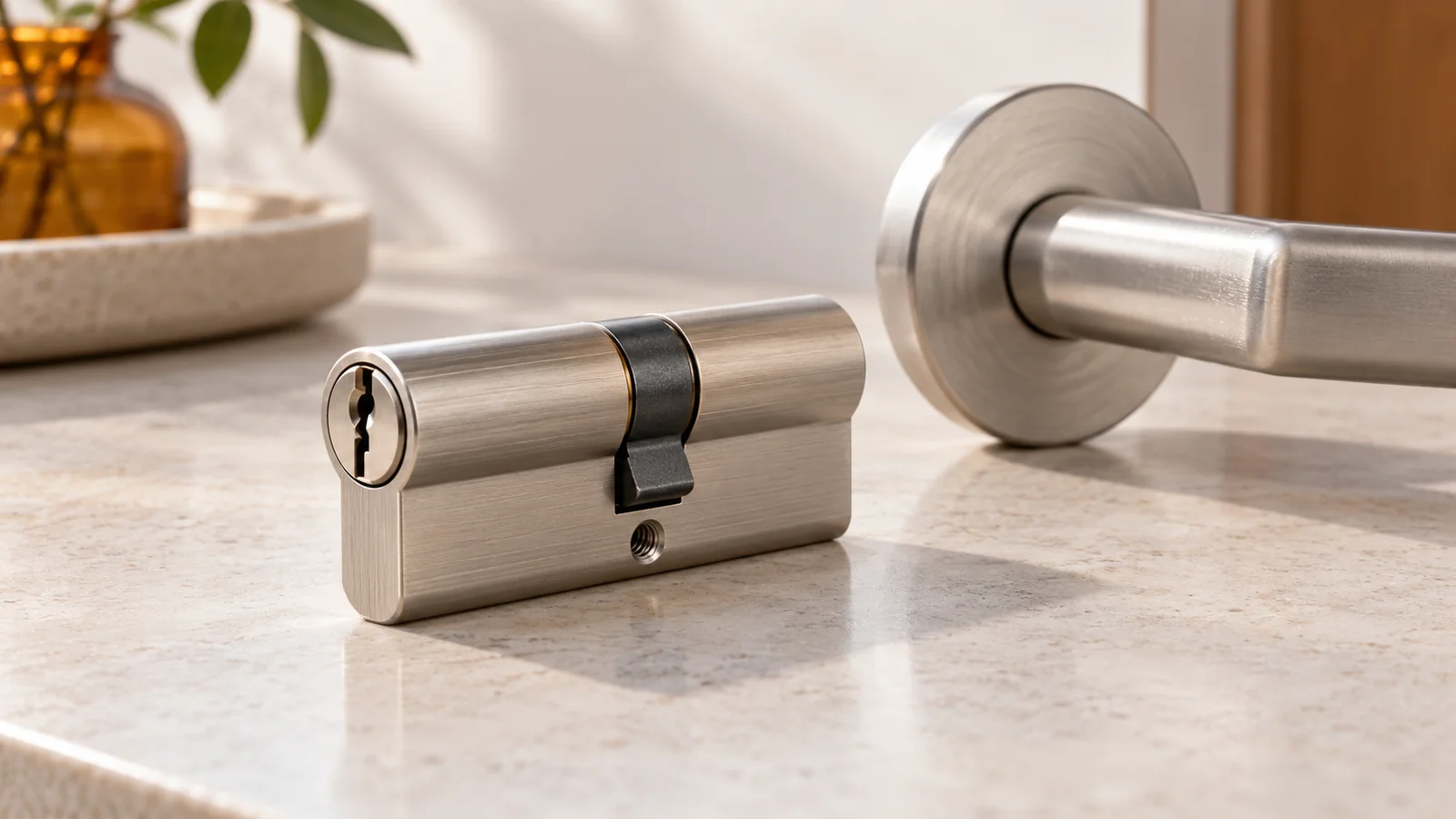
A euro-profile cylinder has a distinctive shape: a round barrel with a flat lower section, rather like a keyhole seen in cross-section. That shape leaves a narrow waist across the middle, where the fixing screw passes through. Older cylinders were designed around key security and weather resistance, and that narrow waist was never intended to resist being broken. Once it fails, the mechanism behind it becomes accessible.
That is as much detail as any homeowner needs, and deliberately so. The useful part is the consequence: on a door of this type, the attack bypasses everything you would normally think of as the security of the door. It does not matter how many locking points the mechanism has, how heavy the slab is, or how good the hinges are. A manufacturer can build an excellent door and a glazing firm can fit the cheapest cylinder in the catalogue into it, and that is a very common combination on homes built or re-doored in the 1990s and 2000s.
Modern cylinders are built to fail usefully instead. They include sacrificial sections that break away under force while leaving the working part of the lock intact and still protecting the door, along with hardened internal components. That design change, not a thicker door, is what closed the gap.
Check your own door in two minutes
You can do all of this from outside with the door closed, and you need no tools.
- Look at how far the cylinder stands out. A cylinder should sit as close as practical to the handle plate. A barrel that projects noticeably beyond the handle or escutcheon is both the wrong length for the door and the configuration anti-snap design exists to address. This is the single most useful thing to look at.
- Look for stars. Rated cylinders are usually marked, and the marking is sometimes on the visible face. Nothing at all is a hint that the cylinder is old, not proof of it.
- Look at the handle plate. A thin, flat plate with the cylinder exposed either side of it is a different proposition from a thick plate with a hardened cylinder guard around the keyway.
- Check your paperwork. If the door was fitted by a glazing company or a locksmith, the invoice may name the cylinder. If anybody has changed a cylinder since, there may be an invoice for that too.
- Do the same at the back. Back doors, side doors and patio doors on the same property are frequently a lower specification than the front, and they are less overlooked by neighbours.
If you are unsure what you are looking at, a photograph of the handle and keyway, taken straight on and from the side, is usually enough for a locksmith to tell you over email.
What the ratings mean
Two markings matter in the UK, and the first one is routinely described incorrectly.
TS007 is not a British Standard. It is a technical specification developed by the Door and Hardware Federation and the Glass and Glazing Federation, and it is recognised within Secured by Design, the police-backed scheme that certifies security products. Calling it a British Standard, as a great many retail listings do, is wrong, and it matters because people then assume it works like BS3621, which is a genuine BSI standard with a Kitemark. TS007 works differently. It rates in stars, and it rates the combination that is fitted to the door rather than one part in isolation.
There are two routes to a three-star result:
- A three-star cylinder that reaches the rating on its own. The protection is inside the cylinder, so the handle you pair it with is a matter of taste.
- A one-star cylinder plus two-star protective hardware, where the handle or security escutcheon is doing a defined part of the work.
Both routes are legitimate, but they behave differently over the life of the door. With the combination route, the rating depends on that hardware staying in place and in good order. Swap the handle for a nicer-looking one a few years later, or let a damaged escutcheon stay damaged, and the rating you paid for is gone without anybody noticing. If you want something that is hard to accidentally downgrade, the three-star cylinder route is the simpler choice.
Sold Secure Diamond is the other marking to look for. It is a separate certification run by Sold Secure, which is part of the Master Locksmiths Association, and it is the rating most commonly treated as the top tier for cylinders. Plenty of good cylinders carry both markings. Either one, on its own, tells you the cylinder has been through an independent attack-testing programme rather than simply being described as "high security" by whoever is selling it.
Snapping is not the only thing a cylinder has to resist
It helps to know what the different features on a specification sheet are actually for, because retailers list them all as if they were interchangeable.
- Picking is defeated by the internal design of the pin system, and by features such as anti-pick pins. This is the attack people imagine most and encounter least.
- Drilling is resisted by hardened steel inserts in specific places inside the cylinder. Advertising that says "anti-drill" without saying where the hardening is tells you nothing.
- Bumping is addressed by particular pin geometries and by anti-bump elements in the keyway.
- Pulling and twisting are addressed partly by the cylinder and partly by the handle and escutcheon, which is why the two are rated as a system.
- Key copying is a separate matter entirely. A patented key profile with a registered key card means copies can only be cut by authorised suppliers against proof of entitlement. That is worth considering if keys have been handed out over the years to builders, letting agents, cleaners or previous occupants.
A certified cylinder deals with most of this as a package. The reason to understand the breakdown is so that you can tell a product that has been tested from a product that has been described.
Buying the right cylinder rather than a cylinder
Cylinders are not one size. They are made in asymmetric lengths, and getting the length wrong is how you end up with the projection problem described above. Three things to settle before you buy anything:
- Measure it properly. The measurement that matters is from the centre of the fixing screw hole to each outer face, recorded as two separate figures, because the inside and outside halves are usually different. Guessing, or buying the length that fitted a different door, is the most common mistake.
- Decide between key-key and thumbturn. A thumbturn opens from the inside without a key, which is far better if there is ever a fire and nobody can find the keys, and is the right default for most occupied homes. A key on both sides prevents the door being opened from inside, which is the point in some situations and a serious hazard in others. Think about who sleeps in the house, not about what sounds more secure.
- Decide whether you want keyed-alike cylinders. Having front and back doors on one key is a genuine convenience, and it has to be specified at the point of order.
Doing it yourself, and where that stops
Changing a euro cylinder is one of the few security jobs genuinely within reach of a confident householder. The mechanical part is straightforward: one long screw through the faceplate, the cylinder withdraws once the key is turned to the right alignment. If you are comfortable with hand tools and you have measured correctly, it is a reasonable job to take on.
What is not a DIY job is anything involving the multipoint mechanism itself, a door that has dropped out of alignment, or a door that is already not locking properly. Fitting a new cylinder into a door with a failing gearbox solves nothing and wastes the cylinder. Nor is it worth attempting on a door still under a glazing warranty, where the installer may have views about who touches the hardware. If the handle is stiff, if the door needs lifting or leaning to lock, or if the key needs persuading, get the mechanism looked at first and change the cylinder as part of that work.
What else is worth doing with the same budget
A certified cylinder on the doors is the highest-value single change on most uPVC and composite properties, because it closes a specific and well-documented weakness. After that, the returns come from unglamorous things:
- Lighting and visibility. An approach that is lit and overlooked is worth more than another lock. Cutting back whatever screens the front door from the street is free.
- The back of the property. Side gates, back gates and alley access tend to be the weakest part of a terraced house in Belfast, and the cheapest to improve.
- Windows. Key-operated handles that actually have keys, and keys kept somewhere sensible but not in the lock.
- Sheds and outbuildings. Tools stored in the garden are worth securing for their own sake.
- The multipoint mechanism. A mechanism that engages fully every time is doing the work the cylinder is protecting. One that half-engages is not.
None of this needs to happen at once. If you only do one thing after reading this, go and look at how far the cylinder projects past the handle on your front and back doors. That one observation tells you most of what you need to know.
Sources
- Door and Hardware Federation
- Glass and Glazing Federation
- Secured by Design
- Sold Secure
- Master Locksmiths Association
- British Standards Institution
- Police Service of Northern Ireland — crime prevention advice
- Northern Ireland Fire and Rescue Service — home fire safety guidance