Does Your Home Insurance Require BS3621 Locks? A Belfast Homeowner's Guide
Somebody tells you that your front door needs a BS3621 lock or your insurance is worthless. Somebody else tells you that nobody ever checks. Both are guessing. The only document that settles it is your own policy, and the only way to know whether your doors match it is to go and look at them. This guide shows you how to do both: what the standards actually are, where the security conditions hide in an insurance policy, and how to read the markings on a lock without taking anything apart.
BS3621 is a standard, not a law
There is no legislation in Northern Ireland, or anywhere else in the UK, that obliges you to fit a particular lock to your own front door. BS3621 is a British Standard published by BSI. It describes a thief-resistant lock that can only be operated by a key from both sides, and a lock earns it by passing a test programme rather than by having a particular number of parts inside.
That last point matters, because the trade shorthand confuses people. You will hear "five-lever" used as if it were the definition of the standard. It is a rough rule of thumb from the days when nearly every certified mortice lock happened to be a five-lever design. The certification is about how the lock behaves under attack, not about a lever count, which is why two locks that look identical from the outside can have different certification.
Three members of the same family turn up in policy wordings and in locksmiths' quotes:
- BS3621 covers locks that need a key on both sides. This is the usual specification for a final exit door, because the door cannot be left unlocked by someone pulling it shut behind them.
- BS8621 covers locks that are keyed outside but open from the inside without a key. These exist for escape: flats, bedsits, houses in multiple occupation and anywhere a hunt for a key during a fire would be dangerous.
- BS10621 sits between the two. It opens from the inside without a key most of the time, but can be locked out of use from the outside when the property is empty.
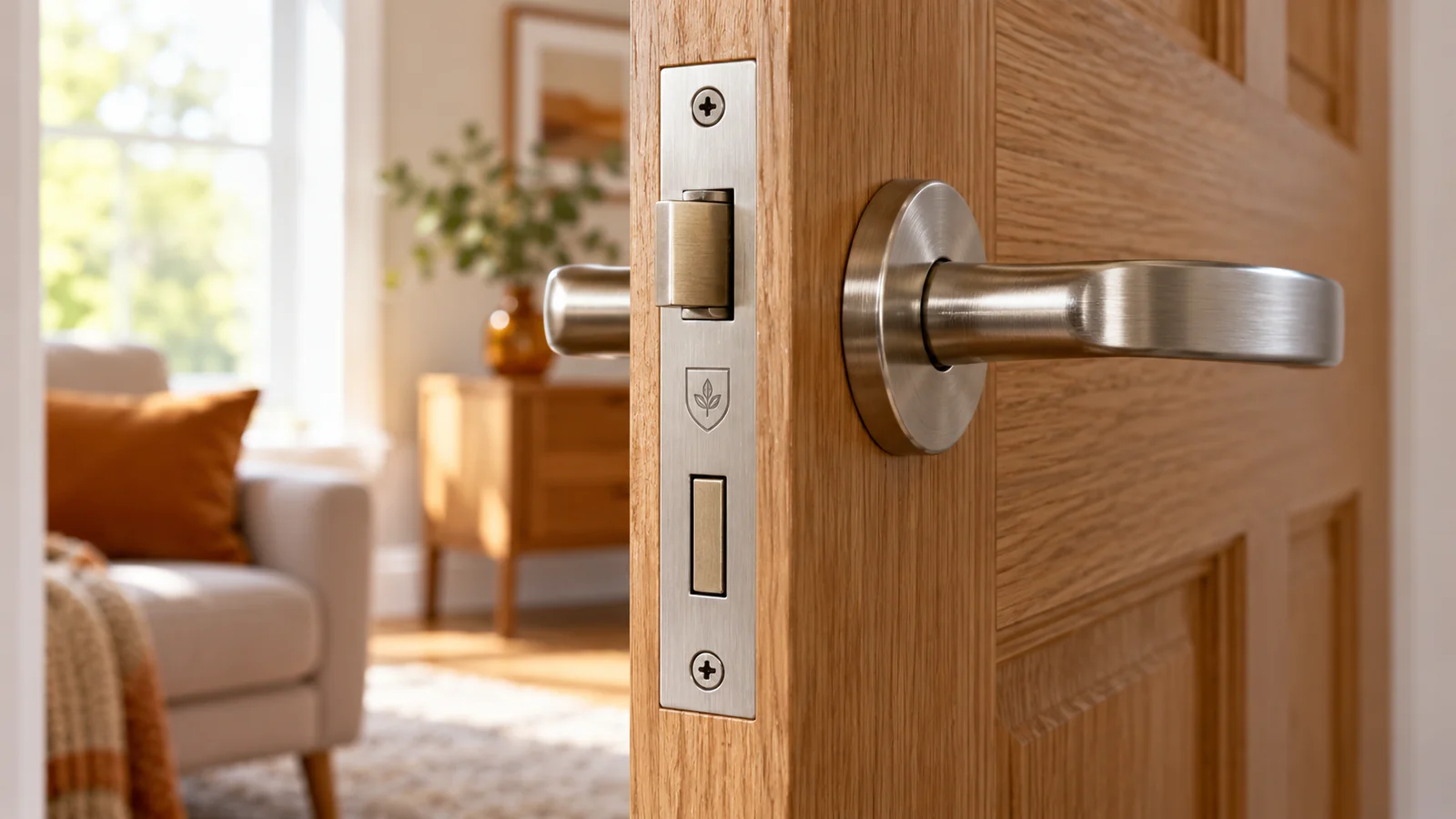
A lock that meets the standard carries the BSI Kitemark along with the standard number. On a mortice lock, that marking is usually stamped or printed on the faceplate, the thin metal strip visible on the edge of the door when the door is open. You do not need to remove anything to read it.
Where the security conditions actually live in your policy
Most people have read half of their policy without realising it. The schedule is the personalised page with your address, your cover levels and your excesses. The policy booklet, sometimes called the wording, is the long document with the general conditions, the definitions and any endorsements. Security requirements are almost never on the schedule. They sit in the conditions, and sometimes in an endorsement added when you took the policy out.
When you find them, they tend to take one of a few shapes:
- A named standard for the final exit door, usually followed by the words "or equivalent".
- A requirement for multipoint locking on uPVC, composite, patio and French doors, without naming a standard at all.
- A requirement for key-operated locks on accessible windows, where "accessible" is defined somewhere in the definitions section and is broader than people expect.
- A condition that the locks must be in use whenever the home is unoccupied, which is a requirement about behaviour rather than hardware.
- Nothing specific at all, just a general obligation to take reasonable care of the property.
That last case is more common than the internet suggests, particularly on policies arranged through a broker for an older property. It is also why blanket statements about what "insurance requires" are unreliable. Two neighbours in the same terrace can hold policies with completely different security conditions.
The phrase to pay attention to is "or equivalent". It gives you room, and it gives the insurer room too. If your lock is certified under a different scheme that tests the same failure modes, you are very likely fine, but what counts as equivalent is decided when a claim is assessed, not when you fit the lock. If you are relying on it, ask the insurer to confirm in writing that your specific lock counts.
What to check in your own policy
Work through these questions with the booklet open. Ten minutes of your own reading is worth more than any article, including this one.
- Does the wording name a standard at all, or does it only describe a type of lock?
- Does it apply to the final exit door only, or to all external doors?
- How does it define an accessible window? Check whether flat roofs, extension roofs, bin stores and boundary walls bring upstairs windows into scope.
- Are outbuildings, garages and sheds covered under the same conditions, or under a separate contents-in-outbuildings limit with requirements of its own?
- Is there an unoccupancy clause, and at what point does the property count as unoccupied?
- Does it ask you to notify the insurer of any change to the security of the property?
uPVC and composite doors are a different conversation
If your front door is uPVC or composite, a BS3621 mortice lock is probably not the relevant question. These doors use a multipoint mechanism driven by the handle and operated by a euro-profile cylinder. The security of that arrangement depends mostly on the cylinder, and on the handle and escutcheon protecting it.
The usual benchmark here is TS007, and it is worth being precise about what that is, because it is widely mislabelled. TS007 is not a British Standard. It is a technical specification developed by the Door and Hardware Federation and the Glass and Glazing Federation, and it is recognised under the police-backed Secured by Design scheme. It uses a star rating, and a three-star result can be reached in two ways: a cylinder that achieves three stars on its own, or a one-star cylinder paired with two-star protective hardware. Those routes are not interchangeable in practice. If the hardware is doing part of the work, the hardware has to stay fitted and intact for the rating to mean anything.
Sold Secure Diamond is a separate certification, run by Sold Secure, which is part of the Master Locksmiths Association. It is the other marking commonly accepted as evidence of a high-specification cylinder. Seeing either marking on the packaging is useful. Keeping the paperwork is more useful, because packaging gets thrown out and the markings on a fitted cylinder are mostly hidden behind the handle.
Trade guidance published for insurers also sets out criteria for the multipoint mechanisms themselves, covering matters such as how many locking points engage and how far the bolts throw. Those are separate criteria, not one combined figure, and they have been revised between editions of the guidance. If a quote or a forum post hands you a single tidy number covering both, treat it as somebody's summary rather than a specification, and ask which edition it came from.
If your doors do not match the wording
Non-compliance does not automatically void a policy, and it does not automatically mean a refused claim either. What happens depends on how the condition is drafted and on what actually happened.
Where a security requirement is drafted as a condition that must be satisfied for cover to operate, an insurer can decline a theft claim if it was not met. Where it is drafted more loosely, or where the breach had nothing to do with the loss, the position is usually different, and UK insurance practice has moved a long way from the days when any inaccuracy could sink a claim outright. Disputes of this kind are exactly what the Financial Ombudsman Service exists to decide, and its published decisions are a better guide to how these clauses bite in real cases than anything a locksmith or a forum can tell you.
Two practical points matter more than the legal theory. First, if you change the locks, tell your insurer, because some policies ask you to and it costs nothing. Second, keep the paperwork. A dated invoice naming the lock, the standard it meets and the door it went on is the cheapest evidence you will ever buy.
Where compliance usually falls over
Front doors get attention. The rest of the property does not. These are the recurring gaps:
- Back doors and side doors fitted years after the front door, often to a lower specification because nobody was thinking about the policy that day.
- Patio and French doors where the multipoint mechanism has stopped engaging properly and nobody has noticed, because the door still shuts.
- Windows with handles that have a keyhole but no key anywhere in the house. A lock that cannot be locked does not satisfy a key-operated requirement.
- Garages with an up-and-over door and an internal connecting door to the house. That connecting door is an external door as far as the policy is concerned.
- Sheds and outbuildings, where the contents limit is modest but the value of the tools stored there is not.
- Communal entrances in flats. The door the policy cares about is the one into your own flat, not the street door.
A sensible order of work
- Walk round the house and photograph the faceplate of every external door lock and the handle of every ground-floor window. Five minutes, and you have a record.
- Read the conditions section of your policy booklet and write down, in your own words, what it asks for.
- Compare the two lists and mark anything you cannot confirm either way.
- Ring your insurer about the gaps and ask them to confirm the answer by email. "Is this lock acceptable on this door" is a fair question and they are used to being asked it.
- Deal with the genuine gaps in order of exposure: ground-floor doors and windows first, outbuildings after.
- File the invoices with the policy documents rather than in a drawer.
One note specific to Northern Ireland
The insurance market here is largely the same as in the rest of the UK, and the lock standards and certification schemes are UK-wide, so the policy wordings you find online will look familiar. What differs is the administration around them. Crime prevention advice and crime reporting go through the Police Service of Northern Ireland, not through forces in England and Wales. Building control here operates under Northern Ireland's own building regulations, so a requirement that applies to new or altered dwellings in England, or in Scotland, does not automatically apply in Belfast. When an article tells you a rule applies "in the UK", check whether it actually means England and Wales before you spend money on the back of it.
If you would rather have someone go round the doors with you, a locksmith on the Master Locksmiths Association register has been vetted and inspected, which is not true of everyone with a van and a website.
Sources
- British Standards Institution — standards for thief-resistant locks
- Master Locksmiths Association
- Sold Secure
- Door and Hardware Federation
- Glass and Glazing Federation
- Secured by Design
- Financial Ombudsman Service
- Association of British Insurers
- Police Service of Northern Ireland — crime prevention advice
- nidirect